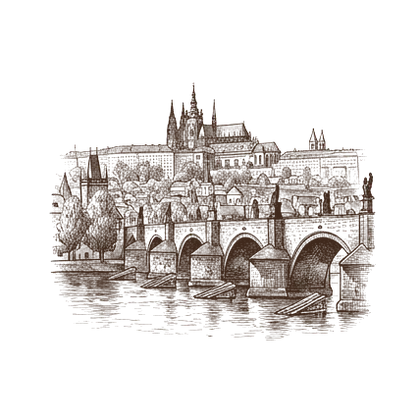
Who Prague suits
Prague suits first-time visitors to Europe who want to see a classic old town without covering huge distances. It is comfortable for couples, families with children, groups of friends and older travellers who prefer simple logistics: from the square to the bridge and the castle, everything is a walk.
Many people build a multi-country Central European route around Prague. Such options are described in our guide to sightseeing tours of Europe. For the rest of the Czech Republic, see the country page.
When to go
Late spring and early autumn are the most pleasant seasons: warm, green, with long evenings on the riverbank. Summer brings crowds to the centre, but the weather is good for walks and river cruises.
December is a season of its own. Christmas markets, the tree on Old Town Square, mulled wine and trdelník make Prague one of the best options if you are deciding where to go for New Year in Europe. January and February are cold and grey, but there are few tourists and hotels are cheaper.
Where to stay
Staré Město (Old Town)
The heart of Prague: Old Town Square, Charles Bridge and narrow lanes. Everything is close, but it is noisy and expensive, with lots of groups out at night.
Malá Strana
The district below Prague Castle on the other bank of the Vltava. Baroque palaces, gardens and quiet evenings. Beautiful and romantic, an excellent choice for couples.
Nové Město
Wenceslas Square, shops and good transport links. Hotels at every level, convenient for families and anyone looking for a balance between price and location.
Vinohrady
A residential Art Nouveau district with parks and cafés, 10–15 minutes from the centre by tram or metro. Calm and local, a good choice for a week-long stay.
What to see
- Prague Castle. The largest castle complex: St Vitus Cathedral, the Old Royal Palace and Golden Lane. Allow half a day.
- Charles Bridge. A medieval bridge lined with statues. At dawn it is almost empty; during the day it is packed.
- Old Town Square. The Orloj astronomical clock, the Týn Church and the town hall with its viewing tower.
- The Jewish Quarter (Josefov). Synagogues and the old cemetery.
- Petřín Hill. A funicular, gardens and a lookout tower.
- Vyšehrad. An old fortress above the river with views and a quiet park.
- The Dancing House and the Vltava embankment.
- A boat trip on the Vltava.
Day trips
- Karlovy Vary: a spa town with mineral springs and colonnades.
- Český Krumlov: a medieval town with a castle in a bend of the river, best with an overnight stay.
- Kutná Hora: the Gothic Cathedral of St Barbara and the ossuary.
- Karlštejn Castle: a Gothic fortress an hour away.
How many days to plan
- 3 days: the Old Town, the Castle, Malá Strana and Vyšehrad.
- 5–6 days: add two day trips.
- 8–12 days: Prague, Vienna and Budapest, or Germany.
Good to know
You need a Schengen visa. Rules are given as of October 2026 and may change: check with our manager or the official embassy website before you travel.
Flights from Tashkent: our manager will find direct and connecting options. The Czech Republic has its own currency, the koruna, though euros are accepted at some tourist spots at a poor rate. It is easier to pay by card and avoid the brightly signed exchange offices in the centre.
The cobblestones in the centre are uneven, so wear comfortable shoes, and plan your route in advance if you have a pram. Public transport, trams and metro, works very well; remember to validate your ticket.
Czech food
Czech cuisine is hearty: goulash with dumplings, duck with cabbage, pork knuckle and svíčková, beef in a creamy sauce. Muslim travellers should check ingredients, as pork is the basis of many dishes; halal restaurants exist but there are not many of them. Street vendors sell trdelník, a sweet pastry roll, and bakeries offer honey cake and strudel. Restaurant prices on the main squares are noticeably higher than a couple of blocks away.
Let us plan your Prague trip
Send a request, message us on Telegram @GlobalDestination1 or call +998 99 760-82-88. Our manager will help with the visa, find flights and a hotel, and if you like, put together a multi-country European route for your dates and budget.