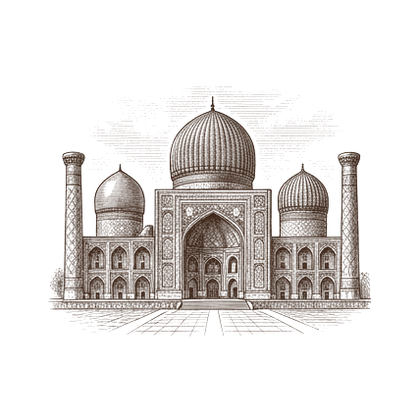
Uzbekistan has the densest concentration of Silk Road monuments in Central Asia, and the four main cities sit along one line from east to west. That makes routing straightforward: the questions are how many nights to give each city and how to cover the long gap between Bukhara and Khiva.
The core route
Tashkent is the arrival point for most international flights. It is a modern capital with a few historic quarters, the metro with its decorated stations, and Chorsu bazaar. One night and a half day is enough for most travellers; more if you enjoy museums.
Samarkand is the visual highlight: the Registan, Shah-i-Zinda, Gur-e-Amir and Bibi-Khanym. Plan two nights at minimum, three if you want a day trip to Shakhrisabz or a slower evening at the Registan.
Bukhara has the most intact historic centre, with dozens of monuments within walking distance of Lyabi-Hauz. Two nights is the minimum; three is better, because Bukhara rewards wandering.
Khiva is compact: the walled inner town of Itchan Kala can be seen in a full day. One or two nights is enough, and staying inside the walls lets you see it at dawn and after the day visitors leave.
Sample itineraries
7 days: the essentials
- Day 1: arrive in Tashkent, afternoon city tour.
- Day 2: train to Samarkand, first sights.
- Day 3: Samarkand in full.
- Day 4: train to Bukhara, evening in the old town.
- Day 5: Bukhara in full.
- Day 6: drive across the desert to Khiva.
- Day 7: Khiva, then train or flight back to Tashkent for departure.
This is tight but works for first-time visitors with limited leave. Expect at least one long travel day.
10 days: a comfortable pace
Add a third night in Samarkand with a day trip to Shakhrisabz, Timur’s home town, and a third night in Bukhara for craft workshops and the summer palace outside the city. Finish with an extra night in Tashkent before departure, which also protects you against a delayed domestic connection.
14 days: going deeper
With two weeks, add the Fergana Valley for ceramics in Rishtan and silk weaving in Margilan, or head into Karakalpakstan for the Savitsky Museum in Nukus and the desert fortresses of ancient Khorezm. A night in a yurt camp in the Kyzylkum between Bukhara and Khiva is another popular addition.
Getting between the cities
High-speed trains link Tashkent, Samarkand and Bukhara, and there are rail connections to Khiva and Urgench as well. Tickets for convenient departures sell out in spring and autumn, so we book them as soon as the program is confirmed. Our train guide covers classes and booking.
The Bukhara to Khiva leg is the longest. A private car through the desert, with a stop at the Amu Darya viewpoint, is the most flexible option. Domestic flights connect Urgench, the airport for Khiva, with Tashkent; our team checks current schedules when building your program.
Which direction to travel
West-bound (Tashkent to Khiva) builds up gradually, ending in the most atmospheric town. East-bound (start in Khiva) puts the grandest architecture, Samarkand, at the end. Either works; the choice usually comes down to international flight times and which domestic connections are available on your dates.
Timing your trip
Spring and autumn are the most comfortable seasons for city sightseeing. Summer in Bukhara and Khiva is hot, so programs shift sightseeing to early morning and evening. Winter is quiet and cold but beautiful in clear weather. See the best time to visit Uzbekistan for a month-by-month view.
Practical points
- Guides make a real difference in Samarkand and Bukhara, where the history is layered and signage is limited.
- Hotels inside or next to the old towns of Bukhara and Khiva save time.
- Keep one buffer day before international departure.
- Dress codes at active mosques and mausoleums apply: covered shoulders and knees.
Plan your route with us
Our Classic Uzbekistan tour follows this route and can be shortened, extended or combined with neighbouring countries. Send us a request with your dates, group size and interests, and we will build a day-by-day program and send you a quote.