post card
Plan your trip
Tell us your dates, group and interests — we reply with a program and a quote.
To: Global Destination
Where: Tashkent, Uzbekistan
Tel.: +998 99 760-82-33
Email: [email protected]
Telegram: @GlobalDestination1
destination
Uzbekistan holds the densest cluster of Silk Road cities in Central Asia. We plan private and group itineraries from our base in Tashkent, for independent travellers and for travel agencies.

best time
April–early June and September–October; summer is hot in the desert cities
highlights
Uzbekistan sits in the middle of the old Silk Road, and its main cities are close enough to see in one trip. Within a week you move from the tiled squares of Samarkand to the mud-brick lanes of Bukhara and the walled town of Khiva, each with a different look and history. The country has also become much easier to visit: rail links between the main cities, more guesthouses and boutique hotels, and card payments in most city hotels.
What travellers remember most is often not the monuments but daily life around them. Bazaars, bread from tandoor ovens, workshops where families still weave silk or paint ceramics, and the habit of inviting guests to the table. A good program leaves room for this rather than filling every hour with sightseeing.
Samarkand, Bukhara and Khiva are the core of almost every first trip. Samarkand is the city of Timur and his descendants, with monumental architecture. Bukhara is a working old town where you can walk for days. Khiva is compact and best seen at sunrise and sunset, when the walls change colour.
Tashkent is the main international gateway. It deserves at least a day for the Khast Imam complex, Chorsu bazaar and the decorated metro stations. From here, travellers who have already seen the classics head to the Fergana Valley for crafts, to Shakhrisabz for Timur’s home town, or west to Nukus and the Aral Sea region.
The Chimgan and Charvak area near Tashkent and the Nuratau mountains between Samarkand and Bukhara add walking, village homestays and a change of pace from city sightseeing.
Uzbekistan also combines well with its neighbours. Many of our guests continue to Kyrgyzstan, Kazakhstan or Tajikistan, as described in the five-country itinerary.
Spring (April to early June) and autumn (September to October) are the best seasons: warm days, cool evenings and fruit in the markets. July and August are very hot in Bukhara and Khiva, so programs then start early and pause at midday. Winter is quiet and cold, but the cities are almost empty and hotels are easier to book. More detail is in our guide to the best time to visit Uzbekistan.
High-speed and regular trains connect Tashkent, Samarkand and Bukhara, and rail lines also reach Khiva and the Fergana Valley. Domestic flights help on longer legs, for example between Tashkent and Urgench or Nukus. For day trips and remote sites, we use private cars and minibuses with drivers. Train tickets sell out in high season, so we book them as early as the timetable allows.
Rules for entry, registration and customs are set by the government and can change. Hotels usually handle the registration of foreign guests; if you stay in private homes, ask us how this works. Cash is still useful in bazaars and small towns, see money and payments. Dress codes are relaxed in cities, but shoulders and knees should be covered in mosques and shrines.
Information checked in October 2026; entry rules change, so confirm with our team or the official embassy website before you travel.
Send us a request with your dates, group size and interests. We build a day-by-day program with hotels, guides, trains and transfers, and send you a quote. Travel agencies can request a net-rate proposal for their own clients.
Updated: 2026-10
Bukhara is the city where travellers slow down. Its old town is still lived in, its lanes lead from mosques to bazaars and courtyards, and the whole centre can be explored on foot.
ReadKhiva's inner town sits entirely within mud-brick walls, with minarets, palaces and madrasas packed into a few hundred metres. It feels like a city frozen in time, and it is best seen slowly, at dawn and dusk.
ReadThe Fergana Valley is the most populated and the most traditional region of Uzbekistan. Travellers come here for silk weaving, ceramics, busy bazaars and a glimpse of everyday life away from the main tourist route.
ReadNukus, capital of Karakalpakstan, is home to one of the most remarkable art collections in Central Asia. It is also the starting point for trips to Moynaq and the shrinking Aral Sea.
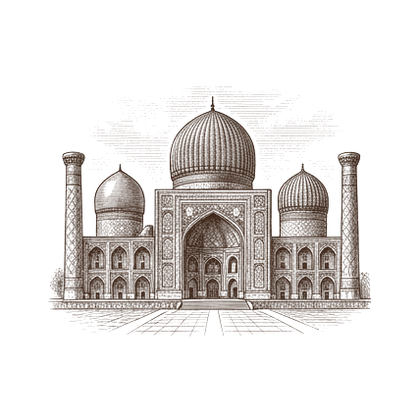
ReadSamarkand is the most famous name on the Silk Road and the centrepiece of most Uzbekistan tours. Its blue domes and tiled squares are the reason many travellers come to Central Asia in the first place.
ReadShakhrisabz, the 'green city', is where Timur was born and where he built his most ambitious palace. It makes a rewarding day trip from Samarkand over a mountain pass.
ReadTashkent is where most trips to Uzbekistan begin and end. It is a big modern capital, but it hides old quarters, a huge bazaar and some of the most beautiful metro stations in the world.
ReadSeven to ten days covers Tashkent, Samarkand, Bukhara and Khiva at a comfortable pace. With twelve to fourteen days you can add the Fergana Valley, Shakhrisabz or Nukus and the Aral Sea region.
Citizens of many countries can enter visa-free for a limited stay, and others can apply for an e-visa. The list of countries and the permitted length of stay change, so check the current rules for your passport before booking; our Uzbekistan visa guide explains the basics.
Trains are the most comfortable option between Tashkent, Samarkand and Bukhara. For Shakhrisabz, the desert fortresses near Khiva or flexible photo stops, a private car with driver works better, and most of our programs combine both.
Yes. We act as a ground handler for tour operators: hotels, guides, transport, train tickets and day-by-day programs under your brand. See DMC services for tour operators.

Samarkand is the most famous name on the Silk Road and the centrepiece of most Uzbekistan tours. Its blue domes and tiled squares are the reason many travellers come to Central Asia in the first place.

Bukhara is the city where travellers slow down. Its old town is still lived in, its lanes lead from mosques to bazaars and courtyards, and the whole centre can be explored on foot.

Khiva's inner town sits entirely within mud-brick walls, with minarets, palaces and madrasas packed into a few hundred metres. It feels like a city frozen in time, and it is best seen slowly, at dawn and dusk.

Tashkent, Samarkand, Bukhara and Khiva form the classic Silk Road loop. Here is how to order the cities, how many nights each one needs and what to add when you have more time.
The essential Silk Road route: Tashkent, Samarkand, Bukhara and Khiva, connected by high-speed train. A good first trip to the region.

April, May, September and October are the classic months for Uzbekistan, but every season has a case. Here is what each part of the year feels like in Samarkand, Bukhara, Khiva and the mountains.
post card
Tell us your dates, group and interests — we reply with a program and a quote.
To: Global Destination
Where: Tashkent, Uzbekistan
Tel.: +998 99 760-82-33
Email: [email protected]
Telegram: @GlobalDestination1