Architecture is the main reason many travellers come to Uzbekistan. The country holds a millennium of Islamic building, from tenth-century brickwork to nineteenth-century palaces, much of it restored and still in use. A guide brings the stories; this page gives you the vocabulary.
The four building types
Mosque
A place of prayer, oriented towards Mecca, with a mihrab, the niche indicating the direction of prayer. Large Friday mosques have big courtyards; neighbourhood mosques are smaller, often with a wooden veranda supported by carved columns. Some are still active, so check dress code and prayer times.
Madrasa
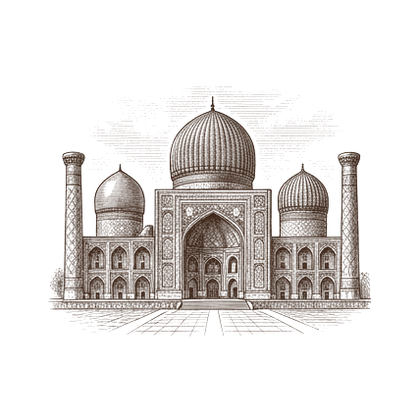
A religious college. The plan is consistent: a monumental entrance portal, a courtyard surrounded by two storeys of student cells called hujra, and domed lecture halls or a mosque in the corners. Many madrasas now house craft workshops and shops in the former cells.
Mausoleum
A tomb for a ruler, saint or scholar, usually a domed chamber with a cenotaph, while the actual burial lies in a crypt below. Mausoleums of revered figures are pilgrimage sites, where you will see families praying.
Minaret
A tower from which the call to prayer was made and which also served as a landmark for caravans. Minarets in Uzbekistan are tall, round and tapering, decorated with bands of brick patterns or tile.
Key architectural terms
- Pishtaq: the tall rectangular portal framing an arched entrance; the face of the building.
- Iwan: a vaulted hall open on one side, usually facing the courtyard.
- Muqarnas: honeycomb-like vaulting that fills niches and transitions between walls and domes.
- Girikh: geometric patterns built from interlocking stars and polygons.
- Majolica and mosaic tile: glazed decoration, painted or cut into pieces and assembled.
- Kufic and thuluth: calligraphic styles used for inscriptions on facades.
How decoration evolved
Early period (ninth to twelfth centuries): decoration came from the brick itself, laid in patterns that change with the light. The Samanid Mausoleum and the Kalyan Minaret in Bukhara are the masterpieces.
Timurid period (late fourteenth and fifteenth centuries): monumental scale, double domes and an explosion of glazed tile in turquoise, cobalt and white. See the Bibi-Khanym Mosque, Gur-e-Amir and the Shah-i-Zinda necropolis in Samarkand, and the vast ruined portal of Ak-Saray in Shakhrisabz.
Shaybanid and later periods (sixteenth to seventeenth centuries): large ensembles and trading domes in Bukhara, and the Sher-Dor and Tilya-Kori madrasas on the Registan, with bold figurative tilework and gilded interiors.
Khanate period (eighteenth to nineteenth centuries): Khiva’s walled inner town, with tiled minarets, palaces with carved wooden columns and intimate courtyards.
Must-see buildings
Samarkand
- Registan: three madrasas framing one of the world’s great public squares.
- Shah-i-Zinda: a street of mausoleums showing the evolution of tilework over two centuries.
- Gur-e-Amir: Timur’s tomb, with a ribbed dome and a gilded interior.
- Bibi-Khanym: one of the largest mosques of its era.
Bukhara
- Poi Kalyan ensemble: the Kalyan Minaret, mosque and Mir-i-Arab Madrasa.
- Samanid Mausoleum: a perfect cube of patterned brick.
- Lyabi-Hauz: madrasas and a khanaka around a historic pool.
- Chor Minor: a small, playful gatehouse with four towers.
Khiva
- Itchan Kala: the walled inner town.
- Kalta Minor: an unfinished minaret wrapped entirely in tile.
- Juma Mosque: a hall with over two hundred carved wooden columns.
- Islam Khoja Minaret: the tallest in the town, with views over the walls.
Visiting tips
- Visit facades in early morning or late afternoon light.
- Look up inside domes and portals; the most refined work is often overhead.
- Respect active religious sites: modest dress, quiet voices, no photos of people praying.
- Take a guide at Shah-i-Zinda and the Registan, where the details are easy to miss.
For the dynasties behind these buildings, see our Silk Road history primer.
An architecture-focused trip
We build programs for architecture enthusiasts, study groups and photographers, with expert guides and time at the key sites in the best light. Send us a request with your interests and dates, and we will prepare a program and quote.